

| Fever threshold (rectal) | 100.4 F (38 C) or above (American Academy of Pediatrics) |
| Age requiring immediate call | Under 3 months with any fever (American Academy of Pediatrics) |
| Fever reducer to avoid in children | Aspirin (risk of Reye's syndrome) (CDC general guidance) |
| Typical viral fever duration | 2 to 3 days (General pediatric guidance) |
| Ibuprofen minimum age | 6 months and older (FDA labeling) |
What a fever actually means
A fever is the body's response to infection, not the illness itself. When immune cells detect a pathogen, they trigger a rise in core body temperature that makes the environment less hospitable to bacteria and viruses. This is a normal, functional process.
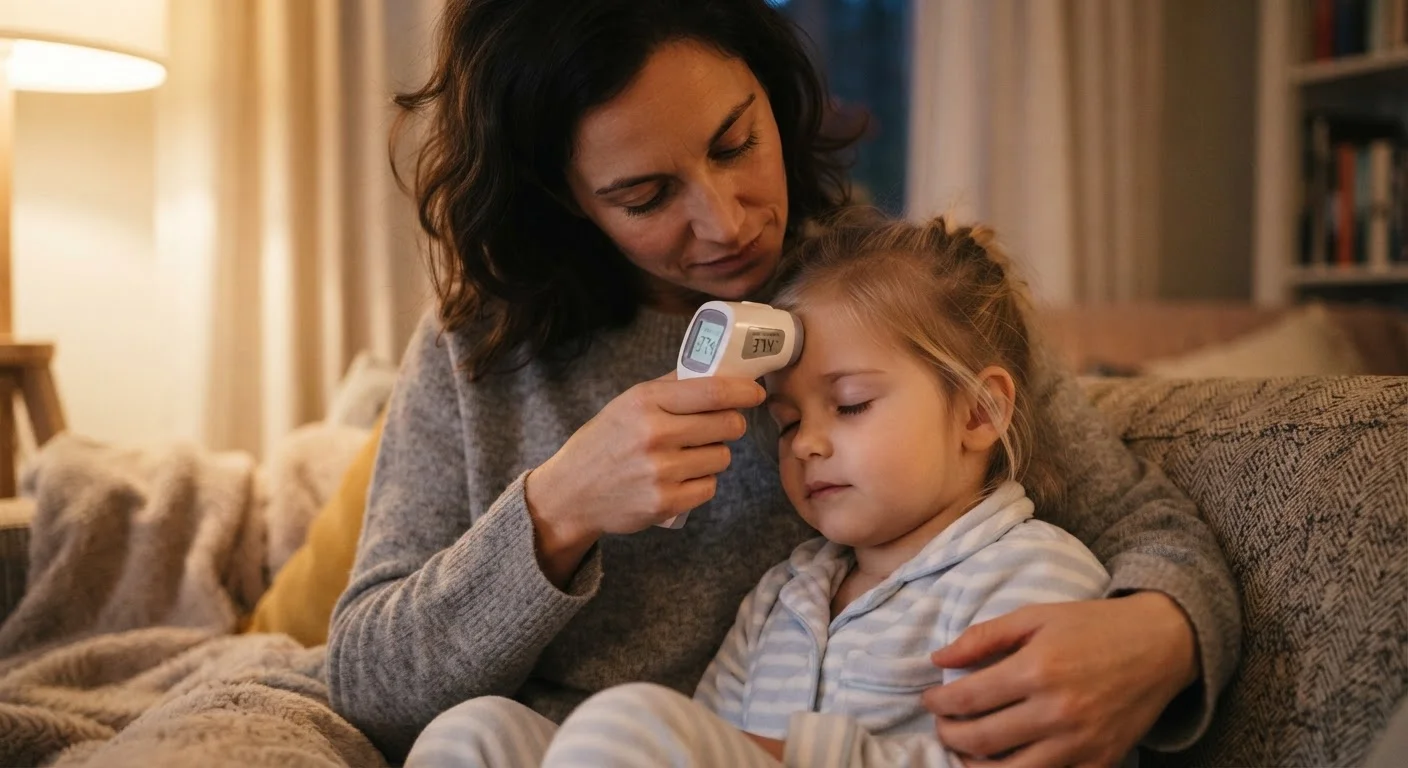
Most pediatric guidelines define fever as a rectal temperature at or above 100.4 degrees Fahrenheit (38 degrees Celsius). Axillary (underarm) readings run about 0.5 to 1 degree lower than rectal, so the same threshold does not apply. For children older than about 4, a forehead or ear thermometer is generally accurate enough for home monitoring, but rectal measurement remains the most reliable in infants under 3 months.
| Fever threshold (rectal) | 100.4 F (38 C) or above (American Academy of Pediatrics) |
| Age requiring immediate call | Under 3 months with any fever (American Academy of Pediatrics) |
| Fever reducer to avoid in children | Aspirin (risk of Reye's syndrome) (CDC general guidance) |
| Typical viral fever duration | 2 to 3 days (General pediatric guidance) |
| Ibuprofen minimum age | 6 months and older (FDA labeling) |
Height of a fever alone tells you less than you might expect. A child with a temperature of 104 F who is alert, drinking fluids, and responding normally is less concerning than a child at 102 F who appears limp, confused, or hard to rouse. Behavior and overall appearance matter as much as the number on the thermometer.
Age-specific guidance
Age changes the rules significantly. The younger the child, the lower the threshold for calling a doctor.
- Under 3 months: Any temperature at or above 100.4 F rectally warrants a call to your pediatrician or after-hours line right away, even if the baby seems fine. Infants this young can deteriorate quickly and have limited ability to signal distress clearly.
- 3 to 6 months: Call your doctor for a temperature at or above 101 F, or lower if the baby seems unusually irritable, lethargic, or is not feeding well.
- 6 months to 2 years: A fever above 102 F that lasts more than a day, or any fever accompanied by symptoms like ear pain, rash, or persistent vomiting, deserves a call to the pediatrician.
- 2 years and older: Fever by itself is less alarming. Focus on comfort, hydration, and behavior. Contact your doctor if the fever exceeds 104 F, lasts more than two to three days, or if the child has a chronic health condition.
This information is general guidance and is not a substitute for advice from your child's healthcare provider. Always consult a qualified professional for your child's specific situation.
Symptoms that change the picture
Certain symptoms, when combined with fever, require prompt medical attention regardless of the child's age or exact temperature reading.
- A stiff neck or severe headache
- Difficulty breathing or rapid breathing at rest
- A rash that does not fade when pressed (a glass test can help: press a clear glass firmly to the skin; if the rash does not blanch, seek care immediately)
- Seizure activity, even if brief
- Persistent crying that cannot be consoled
- Signs of dehydration: no wet diaper in 8 or more hours, dry mouth, sunken eyes, no tears when crying
- Extreme lethargy or difficulty waking
If your child shows any of these signs, do not wait to see if things improve. See our guide to urgent care vs. emergency room to help you decide where to go quickly.
Managing a fever at home
When a fever does not meet the thresholds above and the child appears reasonably comfortable, home management is appropriate.
Keeping a feverish child hydrated is the most consistent priority. Water, diluted juice, broth, and oral rehydration solutions all work. Children with fever lose more fluid through sweating and faster breathing, so offering liquids frequently is more useful than forcing a set amount at once.
Acetaminophen and ibuprofen (for children 6 months and older) can reduce fever and relieve discomfort. Always use the weight-based dosing chart on the package or provided by your pediatrician. Never give aspirin to a child with a fever, as it carries a risk of a serious condition called Reye's syndrome. Do not combine fever reducers without explicit guidance from a healthcare provider.
Light clothing and a comfortably cool room help the child stay comfortable. Avoid bundling a feverish child in heavy blankets. Lukewarm sponge baths are optional; they may reduce discomfort briefly but do not treat the underlying cause and can cause shivering, which raises body temperature.
A fever typically resolves within two to three days with a common viral illness. If the fever persists beyond that window without an identified cause, contact your pediatrician.