

Key Takeaways
Option A
Urgent Care
The accessible option for non-life-threatening issues.
Best for: Families dealing with illness or injury that needs same-day attention but is not immediately dangerous.
Option B
Emergency Room
The full-resource setting for serious or life-threatening conditions.
Best for: Anyone experiencing symptoms that could signal a medical emergency, such as chest pain, difficulty breathing, or major trauma.
If you have a fever, ear infection, or minor cut that needs stitches
Urgent Care
Urgent care clinics handle these conditions quickly and at a fraction of the cost of an ER visit, with no appointment needed.
If someone is experiencing chest pain, stroke symptoms, or severe difficulty breathing
Emergency Room
These symptoms require immediate diagnostic tools and specialist response that only an emergency room can provide.
If a child has a high fever but is alert and responsive
Urgent Care
Pediatric urgent care or a general urgent care clinic can evaluate and treat most childhood fevers without the long ER wait times.
If you have a possible broken bone after a fall
Urgent Care
Most urgent care locations have X-ray equipment and can splint or refer fractures, often faster than an ER for stable injuries.
If you are unsure whether your situation is an emergency
Emergency Room
When genuine uncertainty exists about a life-threatening condition, the ER is the safer choice. You can always be referred down; you cannot always wait.
What each setting is actually built for
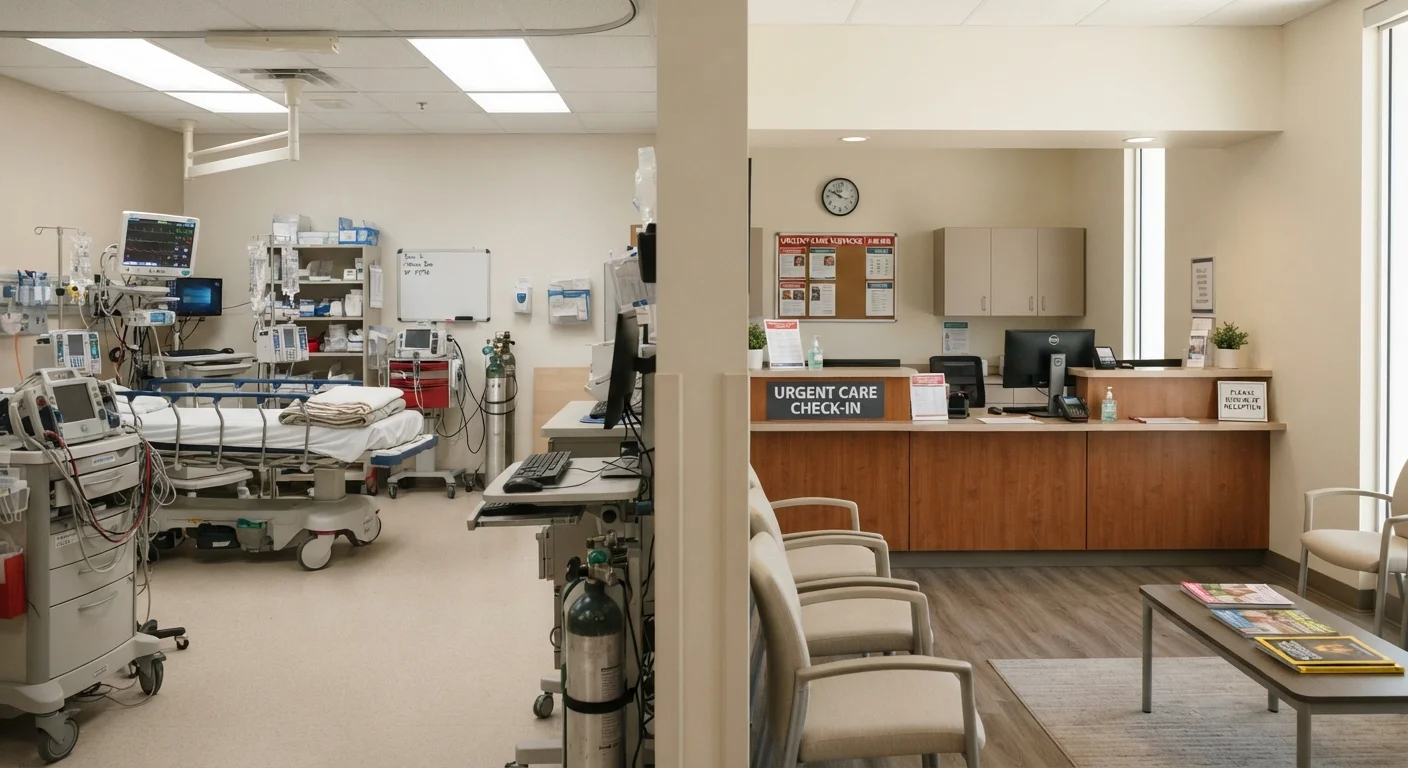
Urgent care clinics exist to fill the gap between a primary care office and a hospital emergency department. They handle conditions that require attention the same day but do not threaten life or require specialized hospital equipment. Most are open evenings and weekends, accept walk-ins, and can treat a wide range of common problems: respiratory infections, urinary tract infections, sprained ankles, lacerations, and mild allergic reactions.
Emergency rooms are equipped for a different level of need. They operate 24 hours a day and have on-site imaging (CT scans, MRI, ultrasound), laboratory services, and access to surgical teams and specialists. Patients are triaged by severity, so someone with a minor complaint will wait behind anyone whose condition is immediately dangerous. That triage system exists for good reason, but it also means an ER is a slow and costly setting for a sinus infection.
Knowing the design purpose of each setting makes the decision clearer before stress takes over.
| Criterion | Urgent Care | Emergency Room |
|---|---|---|
| Availability | Extended hours, usually no appointment | 24/7, always open |
| Typical wait time | 15 to 60 minutes | 1 to 6+ hours for non-critical cases |
| Typical co-pay (insured) | $30 to $75 | $150 to $350+ |
| On-site imaging | X-ray at most locations | X-ray, CT, MRI, ultrasound |
| Specialist access | Limited or by referral | On-call specialists available |
| Best for | Minor illness, injury, infections | Serious, potentially life-threatening conditions |
Cost differences families should know
Cost is a real factor for most families. An urgent care visit typically carries a co-pay similar to a specialist visit under most insurance plans, often in the range of $30 to $75 depending on coverage. An ER visit usually triggers a separate, higher co-pay, often $150 to $350 or more, plus potential facility fees that urgent care does not charge. For families with high-deductible plans, the out-of-pocket gap between the two settings can be several hundred dollars for a single visit.
Families without insurance face even steeper differences. Published ER facility fees frequently run into the thousands before any physician charges are added. Urgent care centers tend to publish flat or lower rates and are more likely to offer payment plans for uninsured patients.
These figures vary by region, insurer, and facility, so checking your plan's cost-sharing schedule before a non-emergency situation develops is worth the time. Your insurance card or member portal usually lists co-pay amounts by setting. Keeping that information with your family medical records means you can find it quickly.
~45%
ER visits classified as non-urgent or semi-urgent
The CDC's National Hospital Ambulatory Medical Care Survey has consistently found that a large share of emergency department visits involve conditions that could be treated in a lower-acuity setting.
3x-10x
Higher average cost of ER vs. urgent care for same condition
Health policy researchers have documented that treating identical conditions in the ER costs significantly more than urgent care, based on insurance claims analyses published in health economics journals.
9,000+
Urgent care centers operating in the U.S.
The Urgent Care Association has reported that the number of urgent care centers in the United States has grown substantially, improving access in many communities.
Symptoms that belong in the ER
Some situations should never wait for an urgent care opening or a primary care slot. Call 911 or go directly to an emergency room for any of the following:
- Chest pain or pressure, especially with sweating, arm pain, or shortness of breath
- Signs of stroke: sudden face drooping, arm weakness, or slurred speech
- Severe difficulty breathing or choking
- Uncontrolled bleeding
- Loss of consciousness or altered mental status
- Suspected poisoning or drug overdose
- Severe allergic reaction (anaphylaxis) with throat swelling or hives spreading rapidly
- Head injury with confusion, vomiting, or seizure
- High fever in an infant under three months old
This is general information, not an exhaustive list. If something feels seriously wrong, treat it as an emergency. Erring toward the ER is always safer than waiting when symptoms are ambiguous. Parents of infants and children with chronic health conditions should discuss specific warning signs with their pediatrician so the guidance is tailored to their child.
Making a faster decision under pressure
Stress makes clear thinking harder. A few practical habits can shorten the decision time when something goes wrong.
Many health insurance plans include a 24-hour nurse advice line at no additional cost. A two-minute call can confirm whether a situation warrants the ER or can safely wait for urgent care. The number is usually on the back of the insurance card.
Knowing the location of your nearest urgent care center and nearest emergency room before you need them removes one decision from a chaotic moment. Some hospital systems also operate freestanding emergency rooms in suburban areas; these carry full ER capabilities but are not always cheaper than a hospital-based ER, so check your insurer's network before assuming they are equivalent.
Practicing good preparation year-round helps too. A complete family first-aid kit handles many minor issues at home, reducing the number of visits to either setting. And when you do see a provider, using strategies for getting the most from short appointments can help you ask the right follow-up questions afterward.
This article is for general informational purposes only and is not medical advice. Always consult a qualified healthcare professional for personal medical decisions, and call 911 for any situation you believe may be life-threatening.