

Key Takeaways
Start here
Why home fitness works without equipment
Build your foundation
The basic movement patterns every beginner needs
Structure your week
Building your first weekly routine
Include everyone
Making it work for the whole family
Refine and continue
Common starting mistakes and how to avoid them
Why home fitness works without equipment
The gym industry has spent decades suggesting that serious exercise requires machines, memberships, and gear. That framing does not hold up. The body is its own resistance tool: push-ups, squats, lunges, and planks all load muscle tissue in ways that produce genuine adaptation. Research consistently shows that bodyweight training improves muscular strength, endurance, and cardiovascular health, particularly for people who are new to regular exercise.
For families on a budget, the practical case is straightforward. There is no commute, no monthly fee, and no waiting for equipment. A cleared section of floor and a consistent schedule are the two real requirements. If you have wondered whether the approach actually works, common myths about home workouts breaks down several widely held misconceptions that the evidence does not support.
Your floor is your gym
A cleared area roughly the size of a yoga mat is enough for the majority of beginner bodyweight exercises. You do not need a dedicated room. A living room corner, a backyard patch, or even a hallway can work. If space is tight, small-space exercise options shows how to adapt moves to limited square footage.
The basic movement patterns every beginner needs
Rather than memorizing a list of exercises, it is more useful to understand the six movement categories that cover what the body does: push, pull, squat, hinge, carry, and core stabilization. Beginners who learn one or two exercises in each category have a complete foundation without ever touching a weight.
Bodyweight training
Exercise that uses the weight of your own body as resistance, with no external weights or machines required.
Progressive overload
Gradually increasing the challenge of exercise over time, through more repetitions, harder variations, or less rest, so the body continues to adapt.
Movement pattern
A category of physical action (such as pushing or squatting) that groups exercises by how the body moves rather than by which specific muscle is worked.
Regression
An easier version of an exercise that reduces the load or range of motion so someone newer or less strong can perform it safely.
Core stabilization
Exercises that train the muscles of the trunk to resist unwanted movement, supporting the spine during daily activities and other exercises.
- Push: push-ups (and easier progressions such as wall push-ups or incline push-ups)
- Pull: doorframe rows or a sturdy low table for inverted rows
- Squat: bodyweight squats, chair-assisted squats for those needing support
- Hinge: good mornings (standing hip hinge with no load), glute bridges
- Carry: walking while holding household objects with proper posture
- Core stabilization: planks, dead bugs, bird dogs
These patterns train the muscles used in daily life: picking things up, carrying groceries, climbing stairs. That connection between exercise and function is part of why bodyweight training translates well to real-world fitness for all ages.
Building your first weekly routine
Two or three sessions per week is a sustainable starting point for most healthy adults who are new to regular exercise. Each session can follow a simple structure: a 5-minute warm-up of gentle movement (marching in place, hip circles, arm swings), a 20-minute working block using a handful of the movement patterns above, and a 5-minute cool-down with light stretching.
A balanced weekly plan covers how to distribute strength, flexibility, and endurance work across the week once you are ready to build on this base. For now, the goal is consistency across several weeks, not intensity. Vary sessions by rotating which movement patterns you prioritize rather than always doing the same circuit.
If a full 30-minute block is hard to fit into a busy day, shorter bouts of movement count toward your weekly total. Movement snacks describes how to weave brief activity bursts into a packed family schedule.
Making it work for the whole family
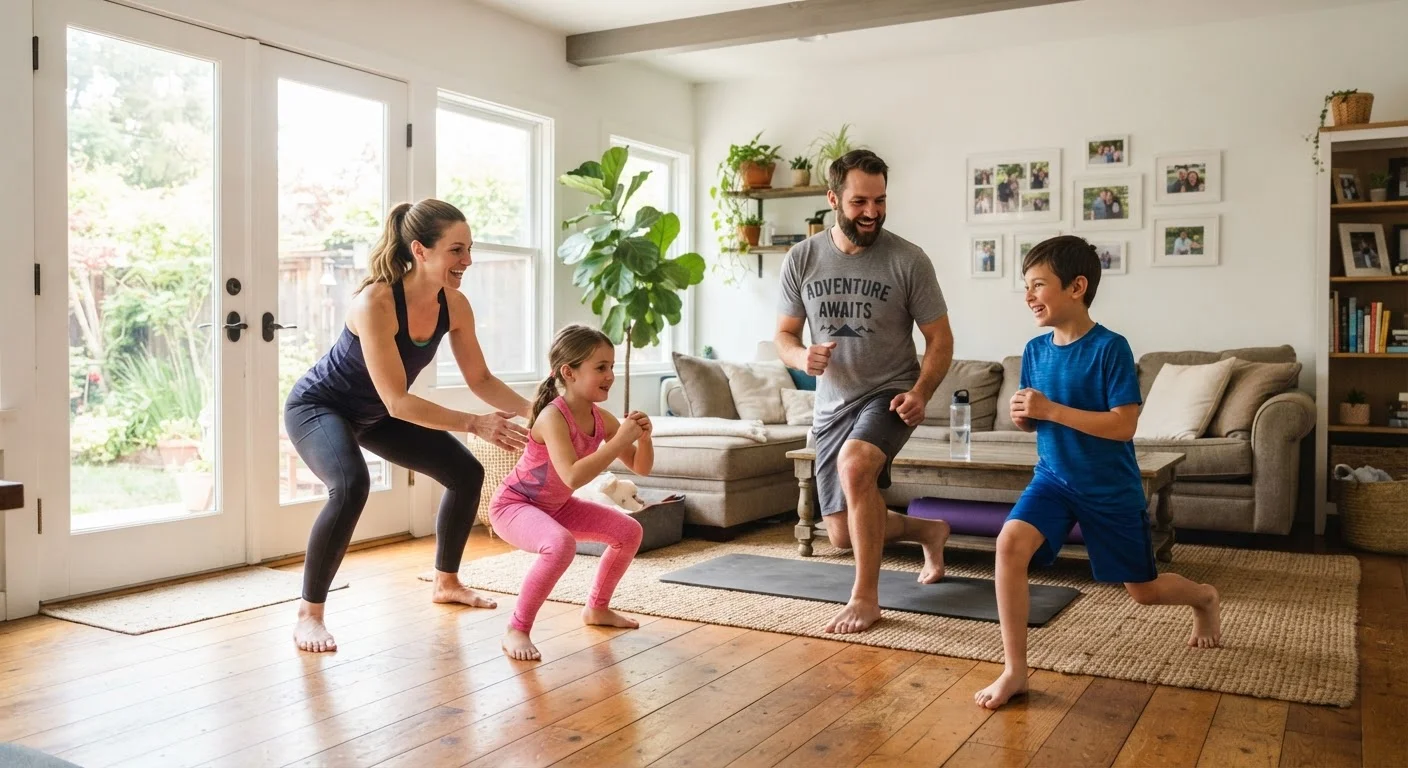
Households with members across different ages and fitness levels can still exercise together. The key is choosing exercises with easy progressions and regressions: a push-up becomes a wall push-up for a child or older adult with limited shoulder strength, while a more conditioned family member does a standard or elevated-feet version.
Keeping sessions short, around 15 to 20 minutes for mixed-age groups, helps maintain everyone's engagement. Children respond well to movement that feels playful rather than repetitive, so structured games that involve squats, jumping, or balance challenges work better than adult-style sets and reps. Multi-generational workout routines offers specific adaptations for kids, parents, and older adults exercising under one roof.
This article provides general fitness information for healthy individuals. Anyone with a medical condition, injury, or health concern should consult a qualified healthcare professional before starting a new exercise program. This applies especially to children, older adults, and anyone who is pregnant or managing a chronic condition.
Common starting mistakes and how to avoid them
The most frequent beginner error is doing too much too soon. Soreness after a first session can feel like progress, but it more often signals that volume was too high. Starting with fewer repetitions than feel necessary and adding gradually over weeks protects against the injury and burnout that stops most people within a month.
Skipping warm-ups is a close second. What warm-ups and cool-downs actually do explains the physiology in plain terms. Cold muscles and connective tissue are less pliable and more prone to strain during sudden effort.
A third common mistake is treating inconsistency as failure. Missing a session does not erase progress. The body adapts over weeks of accumulated stimulus, not from any single workout. The practical response to a missed day is returning to the schedule the next available time, without increasing volume to compensate.
For cardio variety within a home setting, cardio without a treadmill or jump rope covers practical options that raise heart rate without machines or significant space.