

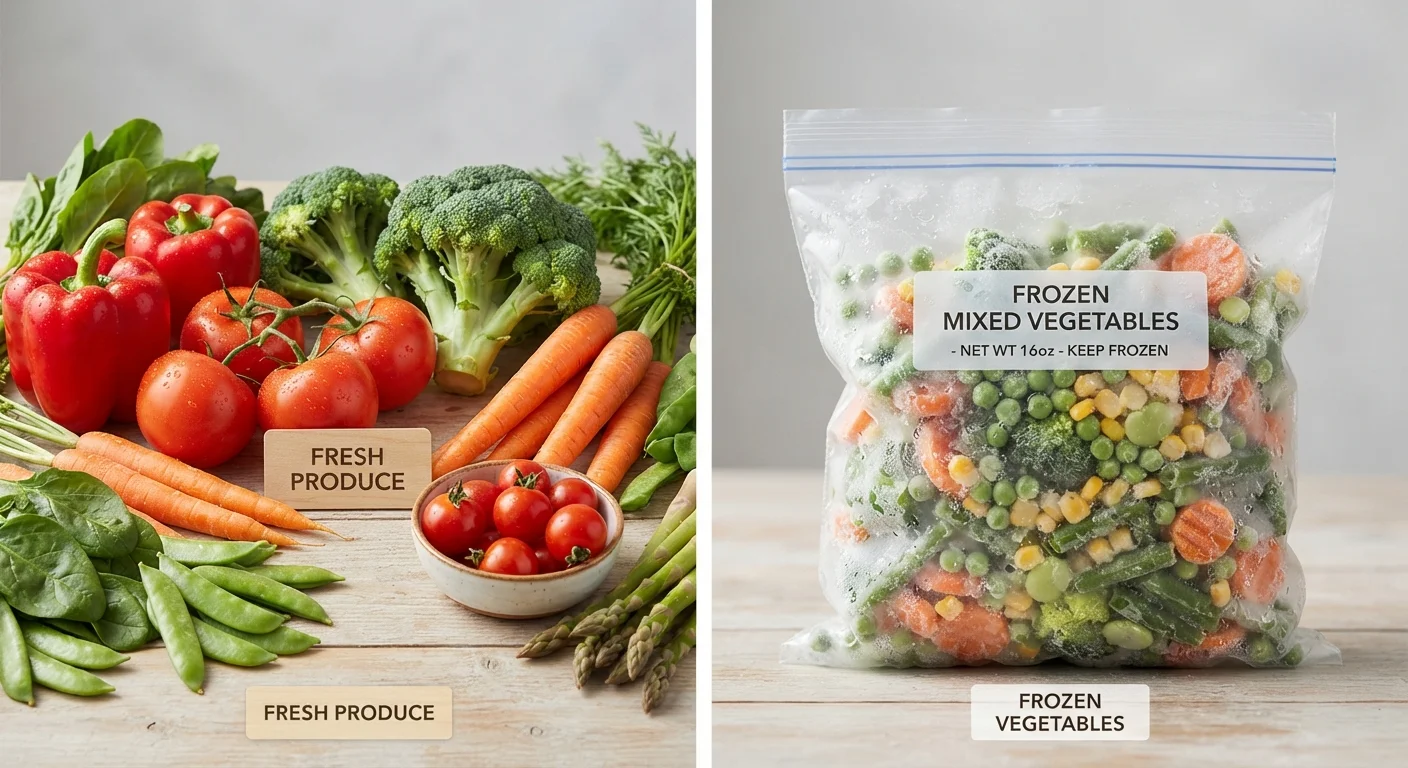
Key Takeaways
Option A
Fresh vegetables
The familiar, market-ready choice.
Best for: Families who shop frequently, eat produce within a few days, and prioritize texture and variety in seasonal cooking.
Option B
Frozen vegetables
The convenient, long-shelf-life alternative.
Best for: Households that want consistent nutrition at lower cost with less food waste and more flexible meal timing.
If you shop once a week or less and worry about produce going bad
Frozen vegetables
Frozen vegetables stay nutritionally stable for months and eliminate the waste that comes with fresh produce spoiling before it gets used.
If you shop at a farmers market or buy local produce in season
Fresh vegetables
Locally grown, recently harvested vegetables have had little time to lose nutrients, and seasonal pricing makes them competitive on cost.
If your household is managing a tight grocery budget
Frozen vegetables
Frozen vegetables typically cost less per serving and deliver comparable or better nutrient density relative to fresh produce stored several days after purchase.
If you need specific textures for salads, slaws, or raw preparations
Fresh vegetables
Freezing alters cell structure, so thawed vegetables are softer and generally unsuitable for raw dishes where crunch and firmness matter.
If you want to reduce time spent on meal prep during a busy week
Frozen vegetables
Pre-washed, pre-cut frozen vegetables require no trimming or blanching and go straight from freezer to pot, saving meaningful prep time on weeknights.
How freezing and storage affect nutrient content
The common assumption is that fresh means more nutritious. The fuller picture is more complicated. After harvest, vegetables begin losing certain nutrients immediately, particularly vitamin C and folate, which are sensitive to heat, light, and time. Fresh produce sold in a typical U.S. supermarket may have spent several days in transit and cold storage before it reaches the shelf, and then additional days in a home refrigerator before it is eaten.
Frozen vegetables are blanched briefly in hot water or steam to halt enzyme activity, then frozen quickly. Blanching does reduce some heat-sensitive vitamins. However, freezing then stabilizes the nutrient content, meaning a bag of frozen spinach bought on Monday and used on Friday contains essentially the same nutrients as it did the day it was packed.
A frequently cited body of research, including work published in the Journal of Food Composition and Analysis, has found that frozen vegetables are nutritionally comparable to fresh ones, and in some cases contain more vitamin C after several days of refrigerated storage at home. The differences across studies are generally small and vary by vegetable type, specific nutrient, and how long the fresh produce was stored.
| Criterion | Fresh vegetables | Frozen vegetables |
|---|---|---|
| Nutrient content at purchase | Declines during transit and storage | Stabilized by freezing after harvest |
| Average cost per serving | Higher, varies by season | Generally lower year-round |
| Shelf life at home | 3 to 5 days refrigerated | 8 to 12 months frozen |
| Food waste risk | Higher, spoils quickly | Low, use only what you need |
| Texture after cooking | Firm, suitable for raw use | Softer, best in cooked dishes |
| Prep time | Requires washing, trimming, cutting | Pre-cut, ready to cook from frozen |
| Variety available | Widest selection, seasonal variation | Good selection, consistent year-round |
The cost and waste math
Nutrition per dollar is a more practical measure for families than nutrition per gram. Frozen vegetables consistently deliver more servings per dollar spent than fresh equivalents. The USDA Economic Research Service has documented that the price per edible cup of most frozen vegetables is lower than the fresh version, once spoilage is factored in.
Food waste compounds the cost gap. The USDA estimates that roughly 30 to 40 percent of the U.S. food supply is wasted, and fresh produce is a large contributor. A half-used bag of frozen broccoli goes back in the freezer; a half-used head of fresh broccoli often goes into the compost bin.
For families building meals around produce that stretches a budget, frozen vegetables are a direct path to lower per-serving cost with minimal nutritional trade-off. Aligning fresh purchases with seasonal availability brings fresh prices down significantly and is worth planning around when your schedule allows it.
What cooking does to nutrients in both forms
Cooking method shapes how many nutrients survive to your plate, and that effect applies equally to fresh and frozen vegetables. Boiling vegetables in a large volume of water leaches water-soluble vitamins into the liquid, which is then discarded. Steaming, microwaving, and stir-frying at high heat for short times preserve more nutrients across both forms.
Microwaving is particularly effective because it uses minimal water and shorter cook times. Studies comparing cooking methods consistently find that steaming and microwaving outperform boiling for retaining vitamin C and B vitamins regardless of whether the vegetable started fresh or frozen.
One practical note: frozen vegetables are often partially cooked during blanching, so they reach doneness faster than fresh. Overcooking frozen peas or green beans until they are gray and soft discards much of the nutritional benefit either form had to begin with. Cook to tender-crisp, and use the cooking liquid in soups or sauces when boiling is unavoidable.
For a broader look at which vegetables deliver the most nutritional return at the lowest price point, see our guide on vegetables that give the most food per dollar.
This article is for general informational purposes only and is not a substitute for professional dietary or medical advice. Speak with a registered dietitian or qualified healthcare professional for guidance specific to your health needs.