

Key Takeaways
Reduces heating and cooling costs over time
A well-insulated home requires less energy to maintain a set temperature. The U.S. Department of Energy estimates that sealing and insulating can meaningfully reduce heating and cooling energy use, though results vary by home.
One-time installation with lasting performance
Most insulation materials, once properly installed, perform for decades without maintenance. Unlike some efficiency measures, there are no recurring costs or consumables involved.
Improves indoor comfort, not just efficiency
Better insulation reduces cold spots near exterior walls and minimizes drafts, which makes living spaces more comfortable in both winter and summer without changing the thermostat setting.
Eligible for federal tax credits and utility rebates
Qualifying insulation materials installed in owner-occupied primary residences may be eligible for a federal energy efficiency tax credit. Some utility companies add their own rebate programs on top of that.
Can improve home resale value
Buyers increasingly ask about energy efficiency, and documented insulation upgrades can be a selling point. An energy audit report showing improved performance gives verifiable information to prospective buyers.
Upfront installation costs can be significant
Professional insulation installation, particularly spray foam or whole-home projects, can run into several thousand dollars. The payback period means the savings arrive gradually over years, not immediately.
Effectiveness depends on proper air sealing too
Insulation slows conductive and radiative heat transfer but does not stop air movement through gaps and cracks. Homes with significant air leaks will see limited savings from insulation alone without accompanying air sealing work.
Some installations require professional work
Spray foam, in particular, requires trained installers and proper protective equipment. Improper mixing or application creates long-term problems that can be costly to correct.
Can trap moisture if installed incorrectly
Insulation installed without adequate vapor management in the wrong climate zone can cause condensation to accumulate inside wall assemblies, eventually leading to mold or structural damage.
Payback period varies widely by situation
Homes in mild climates, with moderate energy prices, or that already have reasonable insulation coverage may see a payback period of ten or more years for some upgrade types.
Our Verdict
Insulation upgrades are one of the more reliable ways to reduce ongoing energy costs in a home, with attic and crawl space projects often paying back their installation cost within a few years. The upfront expense is real, and not every upgrade suits every home, so prioritizing the areas with the most heat loss gives the best return. Combined with air sealing and weatherproofing, insulation improvements compound in value over time.
Homeowners who plan to stay in their home for several years, have older or under-insulated construction, and want a one-time improvement that lowers monthly utility costs without ongoing effort.
Why insulation affects your energy bill
Heat moves from warm areas to cold ones. In winter, that means warmth inside your home is constantly trying to escape through walls, ceilings, floors, and attic spaces. In summer, the process reverses and outdoor heat pushes inward. Your furnace and air conditioner compensate by running longer, which drives up the energy bill.
Insulation slows that heat transfer. It does not stop it entirely, but it reduces the rate at which your conditioned air escapes or outdoor temperatures intrude. The practical result is a system that runs fewer cycles to maintain your thermostat setting. Heating and cooling typically account for the largest share of a home energy bill, which is why reducing that load has a more noticeable effect on costs than most other efficiency measures.
Insulation performance is measured in R-value. Higher R-values mean greater resistance to heat flow. The U.S. Department of Energy publishes recommended R-values by climate zone, and many older homes fall short of those targets, particularly in attics and crawl spaces.
Common insulation types and where they fit
Each insulation material has specific applications where it performs well and others where it falls short.
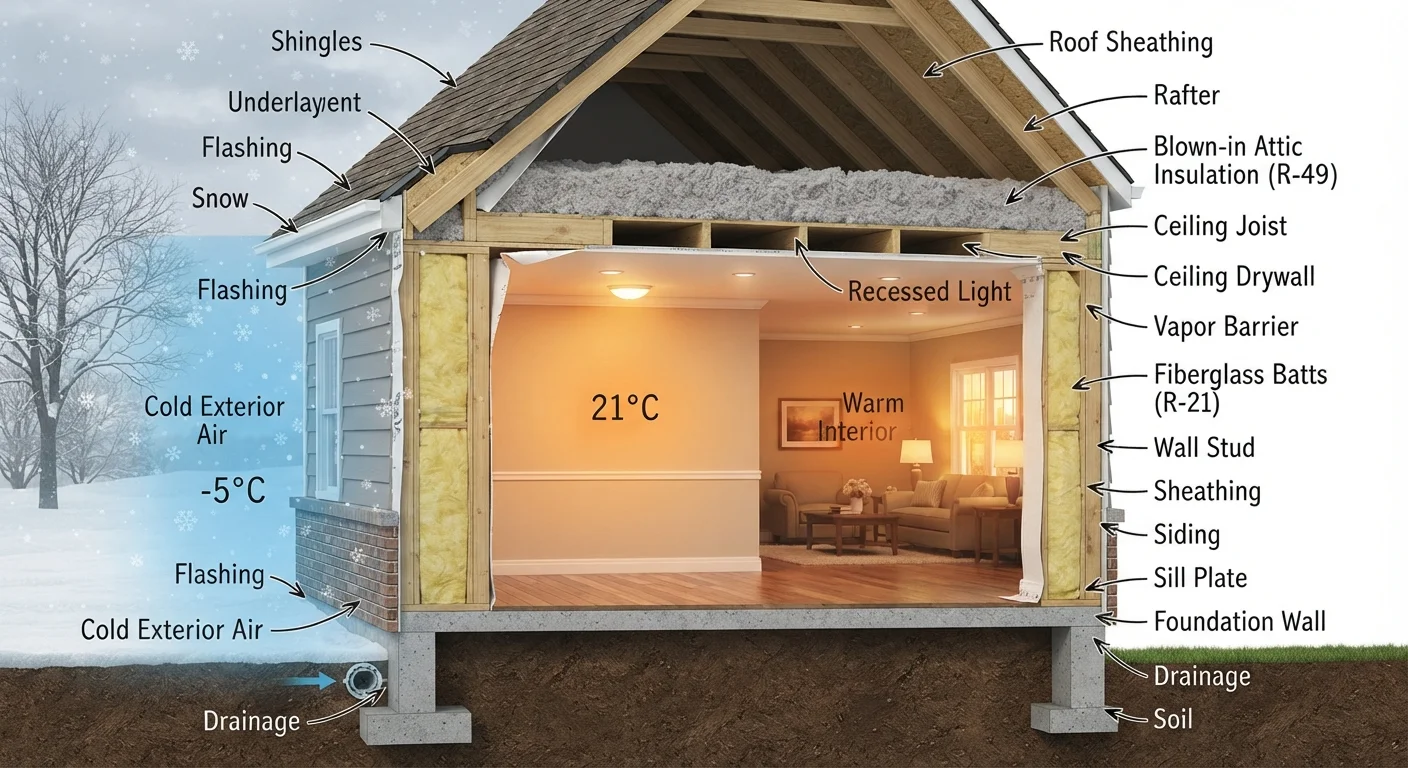
Fiberglass batts are the pink or yellow rolls sold at hardware stores. They fit between standard wall studs and floor joists and are relatively affordable to install, especially for DIY projects in accessible attic floors.
Blown-in cellulose or fiberglass is loose material pneumatically pushed into attic floors or wall cavities through small holes. It works well for adding insulation to existing spaces without major demolition and can fill around obstructions that batts cannot.
Spray foam comes in two forms: open-cell, which is lighter and less expensive, and closed-cell, which is denser and carries a higher R-value per inch. Spray foam also acts as an air barrier, which makes it useful in rim joists, crawl spaces, and irregular gaps where other materials would not seal properly.
Rigid foam board is used on basement walls, under slab foundations, and on exterior sheathing during renovations. It adds R-value in spaces where there is no cavity to fill.
A room-by-room weatherproofing approach helps identify which areas in your specific home lose the most heat, which informs where insulation dollars are best spent.
Pros and cons of upgrading home insulation
Insulation upgrades are not universally straightforward. The benefits are real but so are the costs and complications.
Reduces heating and cooling costs over time
A well-insulated home requires less energy to maintain a set temperature. The U.S. Department of Energy estimates that sealing and insulating can meaningfully reduce heating and cooling energy use, though results vary by home.
One-time installation with lasting performance
Most insulation materials, once properly installed, perform for decades without maintenance. Unlike some efficiency measures, there are no recurring costs or consumables involved.
Improves indoor comfort, not just efficiency
Better insulation reduces cold spots near exterior walls and minimizes drafts, which makes living spaces more comfortable in both winter and summer without changing the thermostat setting.
Eligible for federal tax credits and utility rebates
Qualifying insulation materials installed in owner-occupied primary residences may be eligible for a federal energy efficiency tax credit. Some utility companies add their own rebate programs on top of that.
Can improve home resale value
Buyers increasingly ask about energy efficiency, and documented insulation upgrades can be a selling point. An energy audit report showing improved performance gives verifiable information to prospective buyers.
Upfront installation costs can be significant
Professional insulation installation, particularly spray foam or whole-home projects, can run into several thousand dollars. The payback period means the savings arrive gradually over years, not immediately.
Effectiveness depends on proper air sealing too
Insulation slows conductive and radiative heat transfer but does not stop air movement through gaps and cracks. Homes with significant air leaks will see limited savings from insulation alone without accompanying air sealing work.
Some installations require professional work
Spray foam, in particular, requires trained installers and proper protective equipment. Improper mixing or application creates long-term problems that can be costly to correct.
Can trap moisture if installed incorrectly
Insulation installed without adequate vapor management in the wrong climate zone can cause condensation to accumulate inside wall assemblies, eventually leading to mold or structural damage.
Payback period varies widely by situation
Homes in mild climates, with moderate energy prices, or that already have reasonable insulation coverage may see a payback period of ten or more years for some upgrade types.
One point worth noting: insulation and air sealing are separate but related. Adding more insulation to a leaky attic helps, but it does not seal the gaps where air physically moves. For the best results, air sealing should be done before or alongside insulation work. Routine seasonal maintenance can catch the gaps and cracks that undermine insulation performance before they worsen.
Payback timelines and financial incentives
Up to 20%
Potential heating/cooling savings from insulation
The U.S. Department of Energy estimates that homeowners can save up to 20% on heating and cooling costs by sealing air leaks and adding insulation, though individual results vary.
R-38 to R-60
Recommended attic R-value in cold climates
The DOE's climate zone guidelines recommend attic insulation in this range for most northern U.S. states; many existing homes fall well below this target.
30%
Federal tax credit rate for qualifying insulation
The Inflation Reduction Act established a 30% tax credit on eligible insulation material costs for owner-occupied primary residences, subject to annual caps; verify current terms with a tax professional.
Payback periods vary considerably depending on your local energy prices, climate, the condition of your existing insulation, and which area of the home you upgrade. Attic insulation in a cold climate on a home with little existing coverage tends to have a payback period measured in a few years. Wall insulation in a moderate climate with adequate attic insulation already in place may take considerably longer.
The Inflation Reduction Act includes a federal tax credit for qualifying insulation improvements made by homeowners. As of the time of writing, this covers a percentage of material costs up to an annual cap. Many utility companies also offer rebates for insulation upgrades; checking your utility's website or calling their energy efficiency line is the direct way to find out what is available in your area.
Comparing upgrade costs against the savings shown on prior utility bills gives a reasonable estimate of payback, though actual results depend on behavior, weather variation, and how thoroughly the installation is done. Some energy-saving assumptions overstate the impact, so it helps to separate proven measures from less effective ones.
This article provides general home improvement information only. Consult a licensed contractor or energy auditor for advice specific to your home, and verify current tax credit and rebate details with a qualified tax professional or your utility provider.